Abstract
This academic essay examines the concept of parametricism and evaluates whether—at its current
stage of development—it has already transcended a growing collection of computational methods
to become a coherent architectural style or even a new design paradigm. In recent years,
parametric architecture has gained increasing visibility on the international architectural stage.
This can be observed, for example, at the Venice Architecture Biennale in 2023, as well as in
Germany’s state-funded Cluster of Excellence “Integrative Computational Design and
Construction for Architecture (IntCDC)” at the University of Stuttgart, established in 2019.
Internationally renowned avant-garde studios such as BIG, OMA, and Herzog & de Meuron have
likewise increasingly adopted this architectural language. What these practices have in common is
their production of highly aesthetic and unprecedented formal expressions, which, for many
architecture enthusiasts, appear incomparable to earlier design approaches. The imitation of
natural forms and structural systems, alongside their vast and heterogeneous design repertoire, is
also playing a role in architecture at an unprecedented scale.
However, this essay questions whether a seemingly parametric and visually striking façade alone is
sufficient to justify the emergence of a new architectural style. Is there more to parametricism than
its aesthetic appeal? Does it offer tangible social, ecological, or economic advantages over existing
architectural styles—particularly modernism and its numerous substyles? Ultimately, can
parametricism be regarded as a viable overarching architectural paradigm for the 21st century?
To address these questions, this essay focuses primarily on the writings and projects of Patrik
Schumacher1,2, one of the few practitioners3 who advocates a genuinely holistic conception of
parametricism. In addition to applying parametric methods in practice, he has developed a
comprehensive theoretical framework—most notably through his research at the Computational
Design (CODE)4 group—which positions parametricism as a coherent architectural paradigm.5
The essay is intended for readers with a basic understanding of architecture and an interest in
computer-based design methods. It begins by clarifying the concept of parametric design and
distinguishing between parametric working methods and Schumacher’s holistic understanding of
parametricism. Building on this foundation, the essay outlines the proposed advantages of
parametricism. Since Schumacher coined the term in 20086 and remains its leading proponent,
critical perspectives remain limited. To counter this, the essay engages with public criticism and
develops independent concerns based on a close reading of his writings, before concluding with a
critical assessment of the opportunities and risks of parametric architecture.
Definition of Parametric Architecture (para- [beside]; metron- [to measure])
The general definition:
Parametric architecture is an architectural approach that emphasizes
the use of parameters, rules, and algorithms in the generation, design, evaluation,
analysis, and simulation of buildings, urban patterns, products, or structures. Its defining
characteristic lies in the fact that architectural form—particularly formal and geometric
properties—is not directly prescribed, but rather emerges through the manipulation of
variable parameters. These parameters may influence dimensions, proportions, materials,
façade articulation, structural systems, or other design attributes.
The mathematical definition:
In mathematics, parameters are variables within a function or
system whose values determine its behavior or properties. Parameters are typically represented
symbolically and may assume fixed or variable values.1
Architectural Implementation:
In architectural practice, parametric design requires a
fundamental understanding of rule-based, algorithmic, and hierarchical systems, including logical
sequences of operations and relational dependencies between components. Parametric
methodologies promise the rapid generation of previously inconceivable forms through the
adjustment of parameters and relationships.2 Increasingly, these design processes are accompanied
by integrated analysis and simulation tools, which aim to enhance technical performance, socioeconomic
efficiency, and overall design quality.
Taken together, parametric architecture can be understood as a holistic, computer-based design
approach. Nevertheless, the digital tools employed within this framework encompass several
distinct methodological subcategories: 3
parametric design:
A methodology based on rules and parameters that enables highly
adaptable designs (“function becomes form”).
computational analysis:
Computer-aided methods used to evaluate performance, efficiency, and
quality.
generative design:
Algorithm-driven processes that generate a large number of statistically
informed design alternatives, from which designers select optimal solutions (typically
larger-scale, less detailed).
algorithmic design:
A more controlled approach that relies on precisely defined rules and
parameters to generate one or a few specific outcomes (often smaller-scale and more complex).
combinatorial design:
A subtype of algorithmic design concerned with the rule-based
combination of limited components, resulting in a rich spectrum of possible configurations.
In practice4, computational, generative, algorithmic, and combinatorial design methodologies
depend on parametric rule sets and therefore constitute subcategories within the broader
framework of parametric design.
Theory according to Patrik Schuhmacher
To understand parametricism within Patrik Schumacher’s theoretical framework, it is first
necessary to clarify what parametricism is not. Unlike other architectural styles, parametricism
represents a comprehensive application of algorithmic logic, in which architectural form is
generated from scratch through parametric systems, with project-specific adaptations introduced
only at later stages. Geometry is allowed to emerge through controlled variability, often producing
morphologies that would be difficult to conceive using conventional design processes.
A common misconception arises when parametric tools are used merely to automate pre-existing
design ideas. In such cases, parametricism is reduced to an instrumental technique rather than
understood as a holistic design paradigm.1 According to Schumacher, projects that employ
parametric tools only selectively—such as for façade articulation or surface triangulation—cannot
be considered genuinely parametric, as they lack systemic integration across all design phases.
This strict definition exposes parametricism to criticism, particularly because its holistic
application requires advanced technological infrastructure that is often inaccessible to smaller
practices. Moreover, Schumacher’s theory introduces formal constraints that are frequently
misinterpreted as limitations, although they are intended to promote greater complexity,
adaptability, and fluidity in architectural expression. These constraints include:2
1) Avoid rigid forms (may lack adaptability)
2) Avoid simple repetitions (lack of variety)
3) Avoid a collage of isolated, irrelevant elements (lack of order)
4) Avoid rigid functional stereotypes
5) Avoid segregative functional zoning
Schumacher argues that the rapid expansion of computational design technologies, combined
with the increasing complexity of contemporary networked societies, necessitates the emergence
of a new architectural paradigm.3
Since modernism—widely regarded as the last dominant architectural paradigm—emerged over
80 years ago, subsequent styles grouped under postmodernism are interpreted as transitional
rather than paradigmatic. Minimalist and deconstructivist architectures, in his view, fail to
adequately respond to the socio-economic and cultural complexities of the information age.
Contemporary architecture is thus criticized as retro-rationalist, reproducing spatial logics that
could have been realized decades ago despite operating within a vastly transformed technological
and social context.
In order to address the challenges of the 21st century and to reestablish architecture as a discipline
with meaningful social impact, Schumacher argues that a new paradigm is required.
Parametricism is presented as the only architectural style capable of fully exploiting advances in
computer-aided simulation, analysis, and optimization. Its expansive design repertoire enables
adaptive and responsive geometries capable of addressing the increasing complexity of
contemporary urban environments.1
Another central argument for parametricism lies in the shift from typological to topological
approaches within structural engineering. Advances in simulation technologies have enabled
engineers to manage complex forms more efficiently, facilitating the integration of architecture
and engineering. Traditional typological systems—based on standardized components and
hierarchical subsystems—are increasingly viewed as inefficient. In contrast, topological
approaches treat structures as dynamic, interconnected systems capable of adaptation and
variation. This paradigm shift underscores the necessity of close interdisciplinary collaboration to
address the demands of contemporary construction and urbanism.2
Advantages and Opportunities of Parametricism
One of the central advantages supporting Schumacher’s theory is the concept of legibility and
navigability, as discussed in Tectonism (Schumacher, 2023). Architectural space is redefined as a
field condition, wherein spatial programs are articulated through continuous morphological
differentiation. This approach aims to enhance orientation, comprehension, and intuitive
navigation.1
"Create complexity without losing legibility" (Patrik S., Tectonism p. 34, l. 21)
Key design strategies include:
1) Gradients (color, proportion, tectonics, atmosphere)
2) Curves and ellipses to articulate spatial transitions
3) Minimization of disruptive elements
4) Formation of clusters to enhance readability
5) Elimination of signage in favor of architectural communication
6) Transformation of space into overlapping fields
At the same time, this approach defines superiorities over current architectural styles and design
repertoires:
A) Curved shapes are superior to right-angled shapes
B) Gradient coloring is superior to block coloring
C) Minimalism is greatly inferior to parametricism in its design possibilities and cannot
efficiently deal with advances in engineering technology.
D) Deconstructivism was the first to break with 90° architecture through complex layering of
different structures, introducing design possibilities such as crossing/overlapping,
porosity/openness, and complexity, but at the expense of legibility!
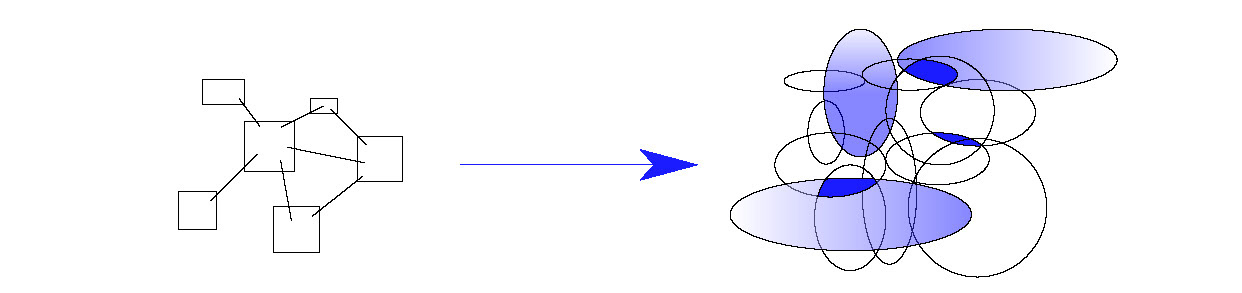
Note:2
From space to field concept: Due to the proliferation of construction projects resulting from increasing social complexity, spaces can no longer be framed and static, but are becoming complex, overlapping, and flowing fields that are used simultaneously.
Criticism and risks associated with parametricism
Despite its theoretical ambitions, parametricism has faced substantial criticism, particularly
regarding its built outcomes. This section examines three projects by Zaha Hadid Architects:
Galaxy SOHO in Beijing, the Riverside Museum in Glasgow, and the London Aquatics Centre.
Criticism 1: Galaxy Soho, Beijing, China
The Galaxy Soho, a building designed by ZHA Architects and completed in China in 2012, has
been eavily criticized. It has remained largely empty since its opening as prices continue to
rise and investors consider it very expensive. One of the main points of criticism is that the
building does not fit into the overall landscape and is more futuristic than the surrounding
buildings. In addition, the rooms are inflexibly designed and receive little sunlight. A blog post by
Wainwright (2013) refers to a letter from the Beijing Cultural Heritage Protection Center in which
they expressed their outrage at the design of Galaxy Soho. The project has caused "great damage to
the preservation of Beijing's old streetscape, the original city plan, the traditional hutongs and
courtyards, the landscaping, and the style and color scheme of Beijing's unique folk
architecture." In addition to its physical and economic shortcomings, this building also has
political problems.
Criticism 2: Riverside Museum, Glasgow, Scotland
This museum, also designed by ZHA Architects, has been criticized for its inability to blend into
the cityscape, and its shape makes no sense when viewed from the air because no one can see it.
Architectural critic Rowand Moore (2016) from The Guardian states that this is "a building whose
zigzag, zinc-clad roof makes it visually striking. Spectacular, but no easier to navigate or inhabit as
a museum." Furthermore, it is not possible for visitors to view the objects up close.
Criticism 3: London Aquatic Center - London, UK
The London Aquatics Centre faced significant criticism regarding obstructed spectator views
during the Olympic Games, particularly from seats located in the upper tiers. Although Zaha
Hadid Architects defended the project by emphasizing that the primary design requirement was to
accommodate a large number of spectators while ensuring clear visibility of the 10-meter diving
events, public dissatisfaction and reports of refunded tickets raised doubts about the building’s
functional success. Beyond issues of visibility, the project has also been criticized for its high
construction costs and technical complexity, which required substantial temporary structures
during the Games and extensive post-Olympic modifications. These factors have led to broader
concerns regarding the building’s constructability, economic efficiency, and long-term
adaptability, calling into question whether the expressive formal language of the design ultimately
compromised practical performance and sustainable use over time.
Conclusion
In light of the criticisms discussed above (pp. 6–7), it is difficult to argue that parametricism
currently possesses the maturity required to function as a new architectural paradigm for the 21st
century. Beyond its strong formal expression, many built examples reveal notable shortcomings in
everyday usability, including inflexible spatial layouts, restricted sightlines, limited daylight access,
and insufficient long-term adaptability. Moreover, the frequent lack of urban integration and
contextual sensitivity often results in buildings that appear detached from their surroundings
rather than meaningfully embedded within them. These issues suggest that, in practice,
parametricism often prioritizes visual impact over social, functional, and urban responsibility.3
Parametric architecture—particularly in large-scale, iconic projects—appears to be increasingly
instrumentalized by powerful institutions or nation states as a means of symbolic representation.
Under this logic, architecture risks being reduced to a visually striking façade that communicates
technological or economic power while failing to address pressing contemporary challenges such
as sustainability, affordability, and social inclusion. This raises doubts about whether
Schumacher’s emphasis on legibility and navigability truly addresses the most urgent architectural
problems of our time.4
Furthermore, the predominance of large-scale projects raises questions about the broader applicability of
parametricism. It remains unclear whether parametric design principles can be successfully transferred to
smaller-scale projects, such as social housing or adaptive reuse, without significantly increasing construction
costs and rents. The widespread adoption of parametricism would also require fundamental changes in
architectural practice, including a stronger reliance on digital specialists, whose long-term efficiency and
social benefit have yet to be convincingly demonstrated.
Nevertheless, rejecting parametricism as a comprehensive architectural style does not imply dismissing
computational design methods altogether. Parametric modeling, generative design, and advanced
simulation tools offer considerable potential when applied critically and selectively. Tools such as Kangaroo
or panelization workflows in Grasshopper demonstrate how complex geometries can be optimized,
prefabricated, and evaluated with unprecedented precision. Ultimately, these technologies should remain
instruments that support architectural judgment rather than autonomous drivers of form. The
responsibility for socially, environmentally, and contextually meaningful architecture must continue to rest
with the architect.
Dorian Prattes, 2023
Appendix:
Patrik Schuhmacher: Tectonism 2023, book
patrikschuhmacher.com, writings on website, individual papers are named.
Hereafter referred to as Patrik S.
Including the university studies of the AADRL at the Architecture Association School in
London, the IntCDC by Achim Menges in Stuttgart, and the ITA at ETH Zurich.
COmputationalDEsign Research Group Zaha Hadid Architects, London.
As stated in footnote 1.
Tectonism, 2023, page 24. l.3
https://www.awork.com/de/glossary/parameter
Basics of Grasshopper as a good introduction
https://constructible.trimble.com/construction-industry/what-is-computational-design
Own investigation of the various possibilities
Parametricism: The Next Decade:
https://www.patrikschumacher.com/Texts/AU%20Parame tricism.html
The Progress of Geometry as Design Resource: https://www.patrikschumacher.com/Texts/
The%20Progress%20of%20Geometry%20as%20Design%20Resource.html
Tectonism 2023, Patrik S. Chapter: Parametricism Against Pluralism pp. 20-23
Tectonism 2023, Patrik S. Chapter: First Premise: Parametricism pp. 15–31
From Typology to Topology: Social, Spatial, and Structural
Patrik Schumacher & Lei Zheng, London 2017: https://www.patrikschumacher.com/
Texts/From%20Typology%20to%20Topology.html
Tectonism 2023, Patrik S. Chapter: Tectonic Articulation, p. 60.78
In search of new possibilities in architecture: https://www.patrikschumacher.
com/Texts/Auf%20der%20Suche_Interview_betonprisma_2019.html
https://www.ktu.edu.tr/dosyalar/ktucodefab_039ae.pdf
In Defense of Parametricism:
https://www.patrikschumacher.com/Texts/In%20Defense%20 of%20Parametricism.html
https://www.fastcompany.com/3063655/the-most-convincing-argument-againstparametric-
design-yet
https://www.architectmagazine.com/design/parametric-design-whats-gotten-lost-amidthe-
algorithms_o
This thesis is further underscored by the enormous proliferation of absurd and simply
inhuman and unecological construction projects, especially in the Middle East. The
Guardian 03.10.2023: https://www.theguardian.com/artanddesign/2023/dec/03/saudi-ara
bia-gigaprojects-mohammed-bin-salman-the-line-iwona-blazwick
It is to be expected that most of the work involved in designing/analyzing and
simulating buildings will no longer be covered by traditional architects. In the future,
most offices will therefore employ additional specialists for these tasks.
Housing shortages are more of a temporary problem:
https://www.destatis.de/DE/Presse/Pressemit teilungen/2023/06/PD23_N041_31.html
However, it should be noted that the design research by Patrik S. and CODE focuses on
social benefits and real problems after being heavily criticized.